


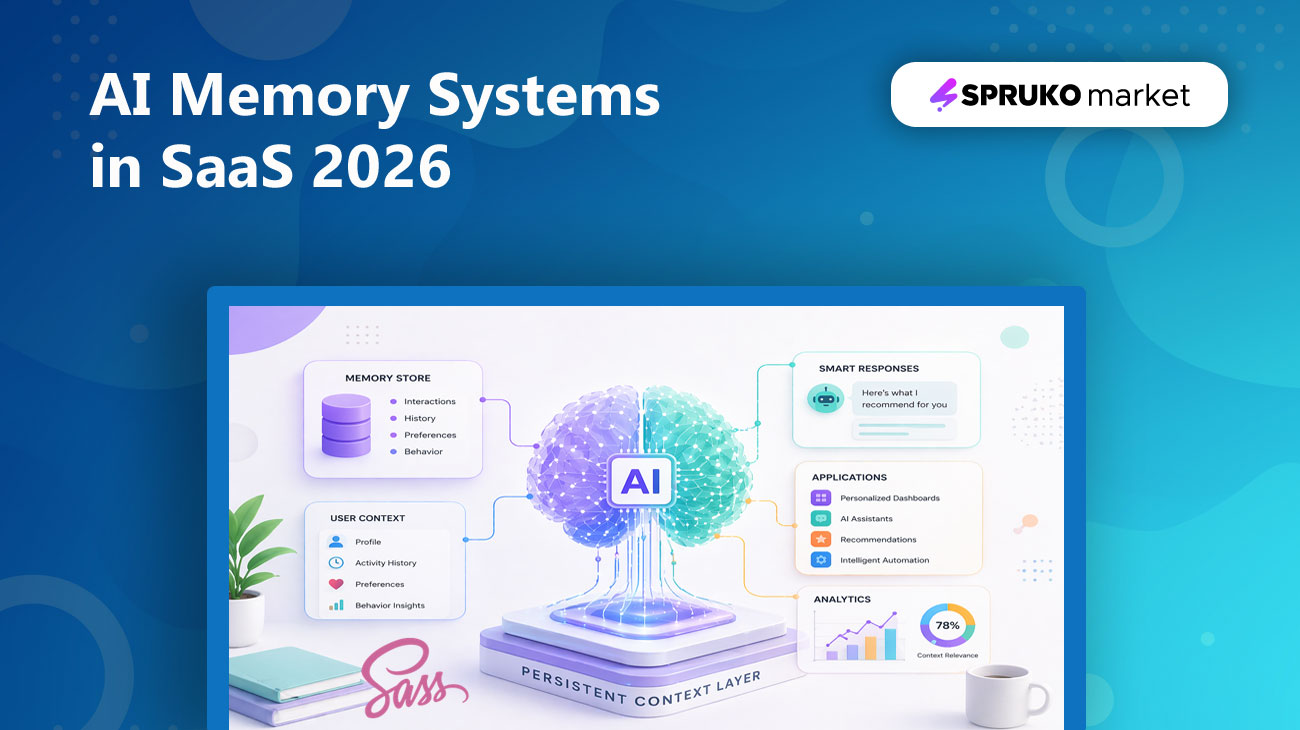
AI Memory Systems in SaaS enable applications to retain user context across sessions, allowing software to deliver personalized, context-aware, and adaptive experiences. By leveraging persistent data such as user behavior, interaction history, and preferences, these systems transform traditional applications into intelligent platforms that continuously improve over time.
In modern SaaS development, artificial intelligence is no longer limited to automation or code generation. The real advancement lies in enabling systems to understand and remember users, creating a seamless interaction layer that evolves with every action. This shift is redefining how applications are designed, moving from static interfaces to dynamic, context-driven ecosystems.
AI memory systems introduce persistent context, allowing applications to learn from ongoing user interactions and optimize responses accordingly. This results in faster workflows, reduced repetition, and more meaningful user engagement—key factors in building high-performance SaaS products.
For developers and product teams, this marks a transition toward building intelligent, adaptive systems that prioritize continuity and user intent. By integrating memory-driven architecture, applications can deliver smarter recommendations, automate decision-making, and enhance overall usability.
To implement these capabilities efficiently, leveraging scalable UI frameworks and production-ready admin dashboard solutions from SprukoMarket provides a strong foundation for developing AI-powered, context-aware SaaS applications.
What Are AI Memory Systems?
AI memory systems are advanced architectural constructs that enable applications to capture, persist, and operationalize contextual data across user interactions. Unlike traditional stateless architectures, these systems introduce a persistent context layer that allows software to evolve beyond isolated request–response cycles and deliver intelligent, adaptive experiences.
From a developer perspective, AI memory systems function as a combination of data pipelines, semantic processing layers, and retrieval mechanisms that continuously learn from user behavior. They transform raw interaction data into meaningful context that can be reused to improve decision-making, personalization, and system responsiveness.

At a technical level, AI memory systems are designed to:
- Persist user interactions, behavioral signals, and activity history in structured and vectorized formats
- Retrieve relevant context dynamically using semantic search, embeddings, and relevance scoring algorithms
- Adapt system outputs based on historical patterns, inferred intent, and user-specific preferences
- Maintain contextual continuity across sessions, devices, and multi-step workflows
- Continuously refine responses through feedback loops and interaction-based learning
Unlike conventional SaaS systems that treat each request as an independent transaction, memory-enabled architectures introduce stateful intelligence. By integrating technologies such as vector databases, retrieval-augmented generation (RAG), and contextual indexing, these systems enable applications to deliver highly personalized, context-aware experiences that improve over time.
Types of Memory in Modern SaaS Applications
AI-driven SaaS platforms rely on distinct memory layers to manage context efficiently across different stages of user interaction. Each layer serves a specific role, enabling systems to balance immediate responsiveness with long-term intelligence.
Short-Term Memory (Session Context)
Short-term memory manages temporary, session-bound data required for real-time interaction. It ensures continuity within active workflows without persisting data beyond the current session.
- Active session state and real-time user interactions
- In-progress workflows and navigation context
- Temporary inputs, filters, and UI states
This layer is essential for maintaining fluid user experiences during live interactions, especially in dynamic dashboards and multi-step processes.
Long-Term Memory (Persistent Context)
Long-term memory focuses on storing user-specific data that persists across sessions. It enables applications to build a deeper understanding of user behavior over time and supports personalized experiences.
- User preferences and configuration settings
- Historical actions and usage patterns
- Behavioral trends derived from past interactions
This persistent layer allows applications to deliver more relevant outputs by leveraging accumulated user context.
Hybrid Memory Systems
Hybrid memory systems combine session-level context with persistent data to create a unified intelligence layer. This approach allows applications to operate with both immediate awareness and historical insight.
- Combines real-time interaction data with stored user context
- Enhances response accuracy and decision-making
- Supports multi-step workflows and contextual continuity
By integrating both memory types, hybrid systems enable SaaS applications to deliver consistent, context-aware experiences that scale effectively with user complexity.
AI Memory System Architecture
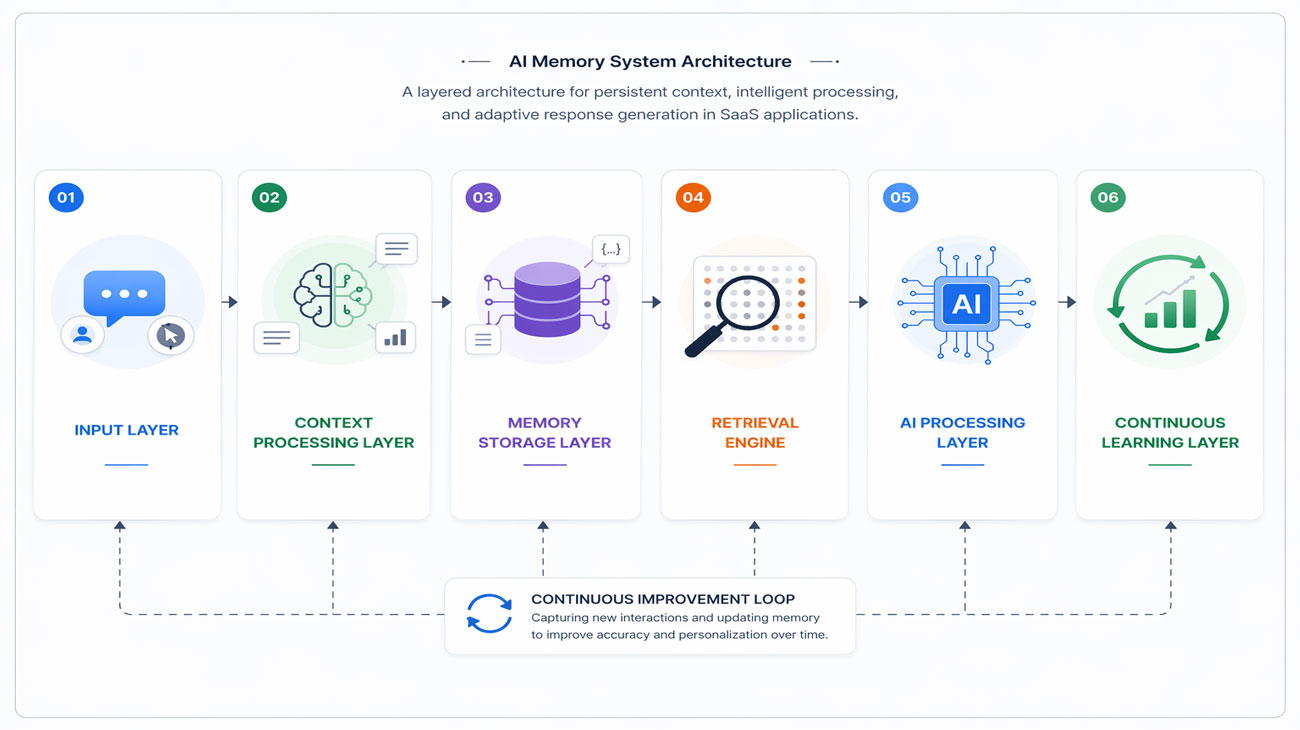
An effective AI memory system in modern SaaS applications is built on a layered architecture that enables seamless context capture, intelligent processing, and adaptive response generation. Each layer plays a critical role in transforming raw interactions into meaningful, reusable context.
Input Layer:
The input layer acts as the entry point for all user-driven signals. It captures and normalizes incoming data from multiple sources, ensuring consistency for downstream processing.
- User queries, commands, and conversational inputs
- Interaction events such as clicks, filters, and navigation
- Application state changes and workflow triggers
Context Processing Layer:
This layer interprets incoming data by extracting intent, identifying key entities, and determining contextual relevance. It prepares enriched input for memory lookup and decision-making.
- Intent recognition and query understanding
- Context enrichment and signal prioritization
- Mapping inputs to relevant historical patterns
Memory Storage Layer:
The storage layer is responsible for maintaining both structured and semantic data, enabling efficient access to historical context and user-specific information.
- Vector databases for semantic similarity and contextual matching
- Relational or NoSQL databases for structured user data
- Metadata indexing for faster lookup and filtering
Retrieval Engine:
The retrieval engine dynamically selects the most relevant context by evaluating similarity, recency, and importance. It ensures that only meaningful information is passed to the generation layer.
- Embedding-based similarity search
- Relevance ranking and context filtering
- Low-latency retrieval for real-time applications
AI Processing Layer:
This layer synthesizes current input with retrieved context to generate intelligent, context-aware outputs. It serves as the core reasoning component of the system.
- Combines real-time input with historical context
- Applies reasoning and response generation logic
- Supports multi-turn interactions and task continuity
Continuous Learning Layer:
The final layer ensures the system evolves over time by capturing new interactions and updating memory stores. This enables ongoing improvement in accuracy and personalization.
- Incremental updates based on user interactions
- Feedback-driven refinement of stored context
- Adaptive learning for improved future responses
Together, these layers form a scalable architecture that enables SaaS applications to move beyond static behavior and deliver intelligent, context-aware experiences that improve with every interaction.
Persistent Context Workflow
The persistent context workflow in AI-driven SaaS applications operates as a continuous feedback loop, enabling systems to capture, process, and refine user context across interactions. This iterative cycle ensures that applications become progressively more intelligent and responsive over time.
- User interactions are captured, including queries, actions, and behavioral signals
- Interaction data is processed and stored as structured records or semantic vectors
- Relevant context is dynamically retrieved during subsequent interactions
- AI models generate context-aware responses by combining current input with historical data
- The system continuously updates memory stores to improve future accuracy and relevance
Result: A seamless, adaptive user experience where applications evolve with user behavior, delivering faster responses, higher personalization, and improved decision-making capabilities.
Why AI Memory Systems Are Essential for SaaS
AI memory systems are rapidly becoming a foundational component of modern SaaS architecture. By embedding persistent context into applications, they enable platforms to move beyond static functionality and deliver intelligent, adaptive experiences that scale with user needs.
- Advanced Personalization: AI memory systems enable deep, data-driven personalization by continuously learning from user behavior and preferences. This allows applications to deliver tailored dashboards, contextual workflows, and highly relevant recommendations that align with individual usage patterns.
- Optimized User Experience: By eliminating repetitive inputs and preserving interaction context, these systems create smoother and more intuitive user journeys. Context-aware interfaces reduce friction, accelerate task completion, and improve overall usability across complex SaaS environments.
- Intelligent Automation: With persistent memory, AI-powered assistants evolve from rule-based tools into adaptive systems capable of understanding user intent over time. This enables smarter automation, proactive suggestions, and more efficient handling of multi-step workflows.
- Scalable Intelligence: AI memory systems provide a scalable framework for managing increasing data complexity and user interactions. They support the development of adaptive SaaS platforms that can intelligently respond to diverse use cases while maintaining performance and consistency.
By integrating memory-driven intelligence, SaaS applications can deliver more meaningful, efficient, and future-ready user experiences—establishing a competitive advantage in an increasingly AI-centric ecosystem.
Practical Use Cases of AI Memory Systems in SaaS
Across modern SaaS ecosystems, AI memory systems are being applied to build context-aware, adaptive solutions that enhance usability, automation, and decision-making in real-world scenarios.
Smart Admin Dashboards:
Modern admin dashboards can be enhanced with AI memory systems to deliver more intelligent and context-aware user experiences. By integrating backend memory layers, dashboards can evolve beyond static data visualization into adaptive interfaces.
- Persist user preferences across sessions for consistent personalization
- Generate tailored analytics views based on historical usage patterns
- Improve workflow efficiency through context-aware UI adjustments
AI-Driven SaaS Platforms:
AI memory systems enable SaaS platforms to transition from reactive tools into adaptive environments that continuously learn from user interactions.
- Dynamically adjust UI and workflows based on behavioral insights
- Recommend relevant features and actions aligned with user activity
- Enhance onboarding experiences with personalized guidance
Intelligent Support Systems:
Support systems powered by AI memory can deliver faster and more accurate assistance by leveraging historical interaction data.
- Retain past support tickets and conversation context
- Provide precise, context-aware responses
- Improve customer satisfaction through personalized support
Developer Productivity Tools:
AI-powered development tools benefit significantly from memory systems by maintaining contextual awareness across coding sessions and projects.
- Store project-level context and development history
- Suggest relevant code snippets and solutions based on prior activity
- Increase development efficiency through intelligent automation
As AI memory systems move from conceptual architecture to real-world implementation, the next step for many teams is transforming these capabilities into scalable digital products. By leveraging persistent context and intelligent workflows, developers can build solutions that go beyond functionality and deliver measurable business value.
To understand how AI concepts can be converted into market-ready solutions, explore how to turn AI ideas into sellable digital products , where the process of moving from experimentation to monetization is explained in detail.
Implementing AI Memory in SaaS Applications
Integrating AI memory systems into SaaS applications requires a framework based approach that aligns data architecture, retrieval logic, and AI processing. A well-designed implementation ensures scalability, accuracy, and long-term adaptability.
1. Define a Memory Strategy
Begin by selecting the appropriate memory model based on your application requirements and interaction patterns.
- Session-based memory: Ideal for real-time interactions and temporary context
- Persistent memory: Enables long-term personalization across sessions
- Hybrid memory: Combines real-time context with historical intelligence for optimal performance
2. Design the Storage Layer
Choose storage mechanisms that support both structured data and semantic context for efficient retrieval and scalability.
- Vector databases for semantic search and contextual similarity matching
- Relational or NoSQL databases for structured user data and system records
3. Build Context Retrieval Pipelines
Develop efficient retrieval logic to ensure the system fetches only the most relevant context for each interaction.
- Implement context filtering and prioritization mechanisms
- Design semantic search pipelines using embeddings
- Optimize retrieval latency for real-time performance
4. Integrate AI Processing
Combine real-time input with retrieved memory to generate intelligent, context-aware outputs.
- Merge user input with historical context dynamically
- Apply AI models for reasoning, generation, and decision support
- Enable multi-step interactions and contextual continuity
5. Optimize, Secure, and Scale
Continuously refine system performance to maintain accuracy, relevance, and security at scale.
- Implement memory relevance scoring and pruning strategies
- Ensure data privacy, compliance, and secure storage practices
- Monitor and improve retrieval accuracy through feedback loops
By following this structured approach, AI memory systems can be implemented effectively within SaaS applications, enabling scalable, context-aware, and high-performance user experiences.
As AI continues to reshape modern application development, teams are increasingly adopting intelligent systems to accelerate workflows, reduce complexity, and enhance product capabilities.
For a deeper look at how these advancements are being applied in real-world scenarios, explore how developers are using AI to build SaaS faster in 2026, where practical strategies and implementation approaches are discussed in detail.
Key Challenges in Implementing AI Memory Systems
While AI memory systems unlock powerful capabilities, their implementation introduces several architectural and operational challenges that must be carefully addressed to ensure reliability, security, and performance.
- Data Privacy and Compliance: Managing sensitive user data requires strict adherence to security standards and regulatory frameworks such as GDPR, along with robust encryption and access control mechanisms
- Memory Optimization and Filtering: Efficiently managing stored context involves prioritizing relevant data, removing noise, and implementing intelligent pruning strategies to maintain system efficiency
- Infrastructure Scalability: Supporting growing volumes of user interactions and contextual data demands scalable architectures capable of handling high-throughput and low-latency operations
- Context Accuracy Management: Ensuring the relevance and correctness of retrieved context is critical to avoid misleading outputs and maintain trust in AI-driven responses
A well-architected system, supported by optimized data pipelines and secure infrastructure, is essential for delivering accurate, scalable, and compliant AI-powered SaaS experiences.
Future of SaaS with AI Memory
The evolution of SaaS is moving toward intelligence-driven platforms where applications are no longer passive tools but active participants in user workflows. AI memory systems are at the core of this transformation, enabling software to understand, adapt, and respond with increasing precision over time.
- Operate as intelligent assistants capable of guiding users through complex tasks
- Deliver hyper-personalized experiences based on continuous behavioral learning
- Adapt dynamically to changing user needs through context-aware decision-making
As these capabilities mature, AI memory systems will transition from optional enhancements to a foundational layer within SaaS architecture—powering the next generation of adaptive, data-driven applications.
Conclusion
AI memory systems are redefining the interaction model of SaaS applications by introducing persistent context and continuous learning. This shift enables developers to build platforms that are more intelligent, efficient, and responsive to user needs.
By combining memory-driven AI capabilities with scalable frontend architectures, teams can create robust SaaS solutions that deliver both performance and personalization at scale.
For teams ready to turn these concepts into production-ready solutions, exploring the curated resources and modern UI frameworks available on SprukoMarket can help accelerate the development of intelligent, future-ready SaaS applications.
